

You’ve probably seen the videos. An athlete kneels on the ground, locks their body in place, and slowly lowers themselves down before explosively pulling back up. It’s called a nordic hamstring curl, and if you spend any time on Instagram or TikTok, you’ve heard it’s the key to “bulletproofing” your knees.
There’s just one problem: most athletes are doing them wrong. And for hockey players, they might not even be worth doing at all.
Let’s break down what’s actually happening during this movement and how to train your hamstrings so it actually translates to the ice.
The Hamstrings Do More Than You Think
When thinking of the hamstrings, most people think of two roles:
- Knee flexion (bending the knee)
- Hip extension (driving the leg backward)
But the third, often overlooked role that is arguably more important is posterior tilt of the pelvis.
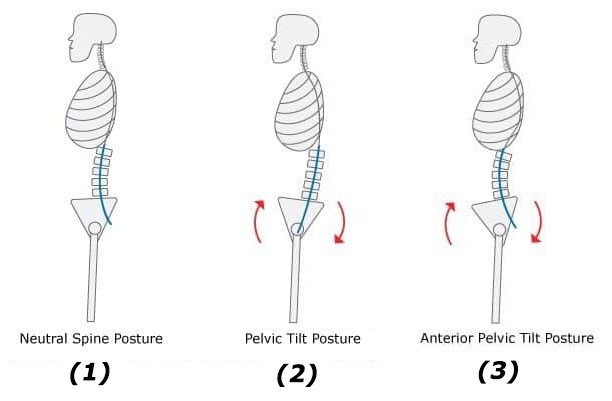
When the hamstrings contract, they pull down on the backside of the pelvis, helping to counteract the anterior (forward) tilt that many athletes live in. And this is where the conversation around movement quality, posture, and performance starts to get really important.
Why Anterior Pelvic Tilt Is a Problem for Hockey Players
Every athlete naturally moves toward extension (anterior tilt). That’s not a bad thing. Extension is required to produce high levels of force and speed.
But problems arise when an athlete gets stuck in that extended position. When the pelvis stays tilted forward (anterior tilt), it creates a ripple effect throughout the body:
The low back gets tight and overworked because the erectors are constantly firing.
The hip flexors get short and tight at the front of the hip socket, often leading to hip impingement or labral irritation.
The abs become stretched and lose their ability to create tension.
The hamstrings feel tight because they’re already long and overstretched, not short and tight. (Think of a rubber band being fully stretched, it would feel tight!)
This combination is known as the lower cross syndrome, where the hip flexors and low back become dominant while the abs and hamstrings become weak and lengthened.
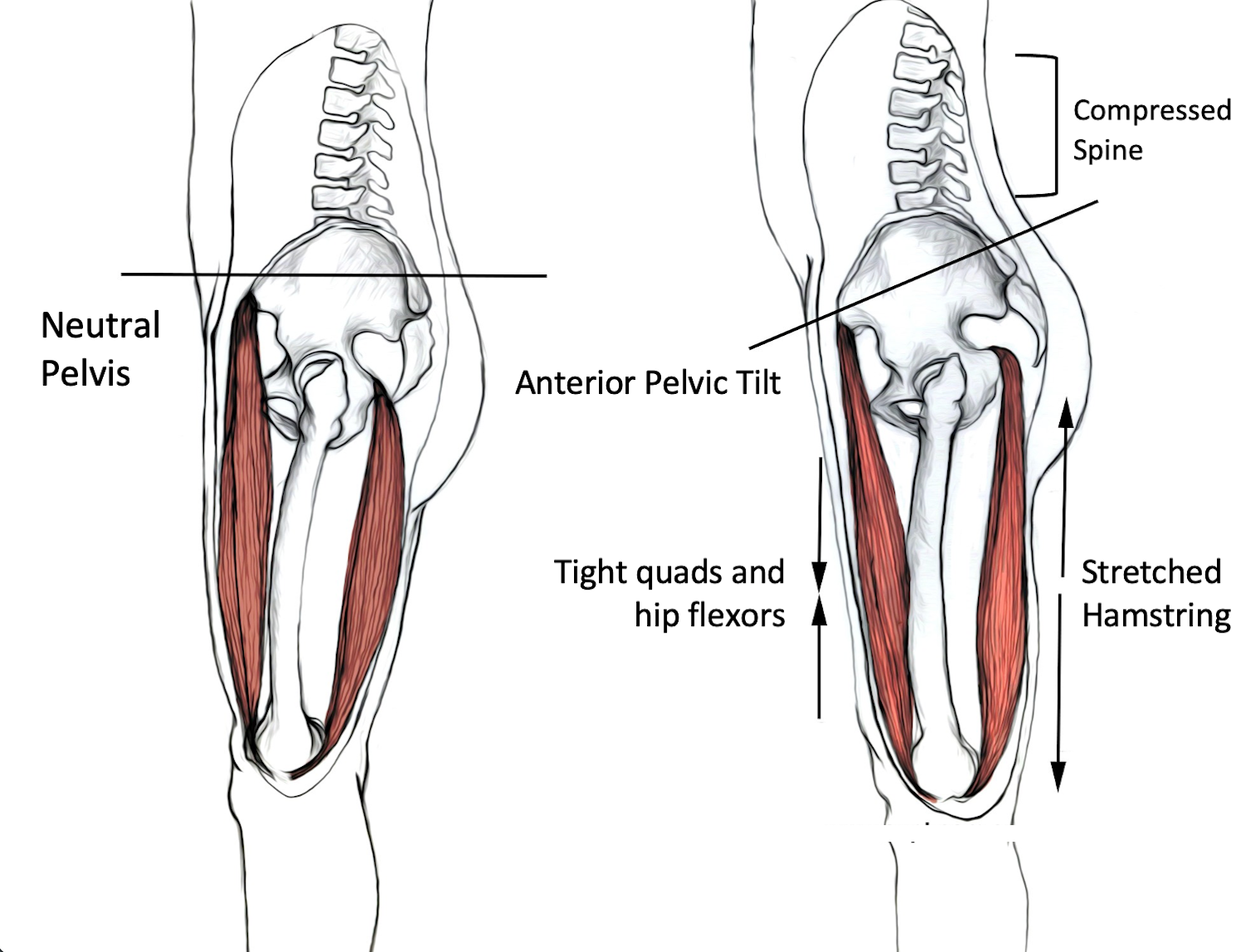
In hockey players, this pattern shows up as tightness after practices and games in the hip flexors, low back, and hamstrings.
This isn’t just about muscles, either. It’s also about the nervous system.
When the body is stuck in an anterior tilt, it’s essentially in a state of fight or flight. Evolutionarily, that posture prepared humans to run, jump, or fight against predators. It’s a high-output, high-stress state. But if you never come out of that position, your nervous system stays ramped up. It affects sleep, recovery, mood, and even cognition.
So, learning to restore a neutral pelvis isn’t just about performance. It’s about getting your body out of constant stress mode so you can recover properly.
Training to Fix the Tilt
When designing off-ice training for hockey players, the goal isn’t to eliminate extension, it’s to teach the body how to move in and out of it. Like I stated previously, extension is what drives force production and speed, so you don’t want to get rid of it.
As an athlete, you want to be able to access both positions when necessary. That means restoring the ability to achieve a more neutral pelvic position through strength and control of the muscles that stabilize it.
To get there, we need tension from both sides of the pelvis:
On the front side, the abs pull upward. Think planks, side planks, anti-rotation presses, etc.
On the back side, the hamstrings pull downward. Think hip lifts, leg curls, RDLs, etc.
Together, these create a neutral pelvis because it pulls the pelvis posteriorly from an already anteriorly tilted position.
The Problem with Nordic Hamstring Curls
Now that we understand the role of the hamstrings and the pelvis, let’s revisit the Nordic curl.
When most athletes perform this exercise, they start in a strong, extended position — hips tilted forward, low back arched, ribs flared. That’s the same anterior tilt we’re trying to get out of.
Without ground feedback like in a hip lift or leg curl to push your low back into the ground (by posteriorly tilting your pelvis), the athlete has no sense of where their pelvis is in space. So they default to the anterior tilt where they’re naturally strongest.
On top of that, being in this extended position actually makes the Nordic curl easier. When your shoulders are slightly behind your center of mass at the bottom of the movement, your body acts like a counterweight, reducing the torque demand on the hamstrings.
So not only is the movement often performed in a biomechanically poor position, but it’s also less effective at loading the hamstrings through their true range of motion.
Does the Nordic Curl Even Do What People Think It Does?
The Nordic hamstring curl exploded in popularity because of research in football and soccer showing it could reduce hamstring strains while sprinting. But here’s the thing, sprinting in skating is drastically different from sprinting on the field.
During a hamstring strain in sprinting, the muscle is loaded in a lengthened position. The hip is flexed while the knee is extending forward. That’s not what happens in a Nordic curl, where the hip is extended the entire time.
So even in field sports, the Nordic curl doesn’t perfectly replicate the range of motion or muscle function where strains occur.
And in hockey, the difference is even more pronounced. Hockey players don’t have the same over-stride or front-leg extension pattern as sprinters. The skating stride keeps the stance leg under the center of mass. So applying the same exercise logic from sprinting or football to hockey doesn’t make much sense.
Better Hamstring Exercises for Hockey Players
For hockey players, there are simpler, safer, and more effective ways to strengthen the hamstrings and restore proper pelvic alignment:
- Romanian Deadlift (RDL) Variations – Both bilateral and single-leg versions teach athletes to hinge through the hips while maintaining core control.
- Hip Lift Variations – Feet-elevated, shoulder-elevated, or barbell-loaded variations all help athletes feel the posterior tilt and build strength at the hips.
- Leg Curls – Whether performed on a machine, stability ball, or slideboard, these are easier to execute with proper mechanics and can still emphasize eccentric control.
These exercises give the body feedback, whether the ground, the bench, or the implement, which makes it easier to stay in good positions and reinforce the neutral pelvis we’re looking for.
If You’re Going to Do Nordics, Do Them Right
That doesn’t mean the nordic curl has no place. It can be valuable when performed correctly and progressively.
Start by mastering your pelvic and rib cage position. Posteriorly tilt your pelvis (as if tucking your tail between your legs) and then reach your arms forward to protract your shoulders and let your sternum pull back. This activates your obliques and keeps your ribs stacked over your hips.
From there, begin with isometric holds. Lean forward a few inches and hold while breathing.
You can progress by increasing the range of motion as your strength improves.
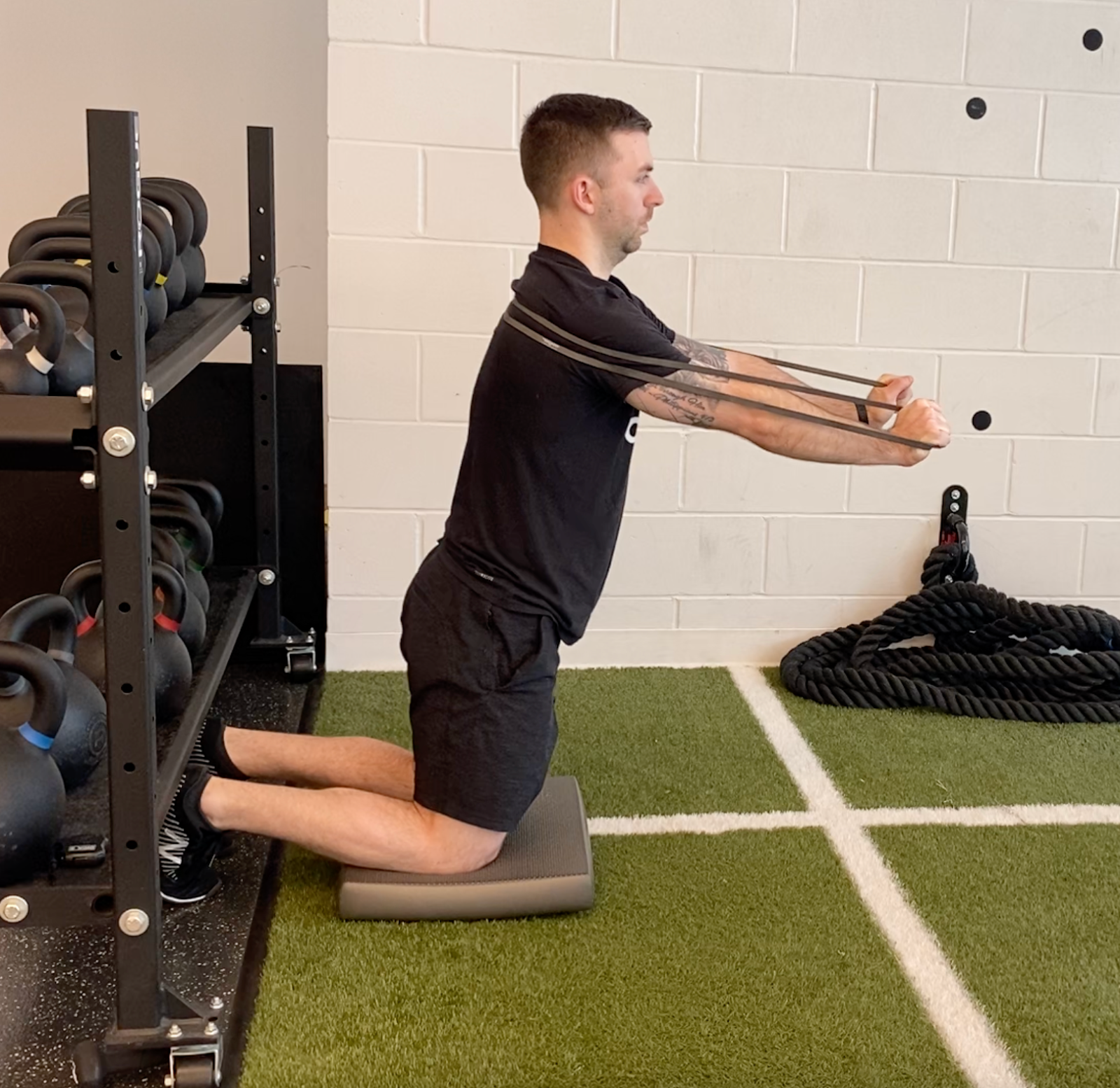
Following mastering the isometric version, you can continue the range of motion to perform a full range, eccentric only nordic curl. Since you’ve increased your isometric range of motion as you’ve gotten stronger, you should only have to lower another foot or two until you’ve reached the bottom of the range of motion.
Then, once you can control the full range eccentrically, you can add load by hugging a medball to your chest to increase the intensity.
The goal with any of these progressions is to keep your hips extended but neutral, and your rib cage down but not flexed. Even if that means reducing your range of motion, staying on a progression longer, or even regressing back to an easier version.
The Takeaway
Most athletes (and especially hockey players) think of their legs in terms of quads and glutes. But the hamstrings are arguably just as, if not more, important.
They don’t just bend the knee or extend the hip. They control the pelvis, stabilize the core, and set the foundation for how efficiently force is transferred through the body.
When your pelvis is in a better position, your quads and glutes work from better leverage. You’re stronger in battles, more powerful in your stride, and more efficient in every movement.
So don’t just copy what looks impressive on ESPN or instagram. Get out of constant extension, train your hamstrings intelligently, and start building strength in positions that will carry over to the way hockey is played.
Leave a Reply