

If you want to achieve your hockey dreams and live up to your true potential on the ice you need to make sure you aren’t making common mistakes that hold hockey players back.
In today’s article, I’m going to cover 3 devastating mistakes I see a lot of hockey players make, both on the ice and in their training.
These are mistakes that can make the difference between making a team or getting cut, or between being a star player on your team or a player who doesn’t make much of a difference on the ice.
I was guilty of all 3 of these mistakes when I was a kid, and I know they held me back from playing at a high level.
Let’s look at the mistakes you need to avoid…
1 – Focusing Only On Your Strengths
2 – Not Addressing The Underlying Problem
3 – Training Hard At The Wrong Things
Focusing On Only Your Strengths
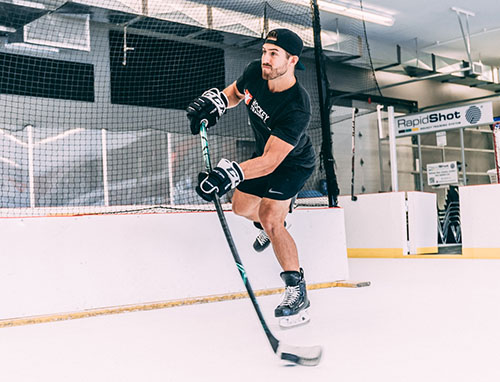
When you do something that you aren’t great at it doesn’t feel good.
Bringing the context away from the rink, It’s why some students hate math, while others don’t mind doing it.
If you aren’t good at it, it’s not going to be enjoyable for you.
If you fan on almost every slap shot you try to take, it’s going to be discouraging and you probably won’t enjoy taking slap shots.
Or if you can’t perform edge work drills on one foot you will probably try and avoid doing drills on that side.
It’s a natural reaction in the body to do things that make us feel good, which is why hockey players are drawn to practicing whatever they are best at.
If you’ve got an awesome wrist shot but can’t take a good backhand shot for the life of you, you are probably going to be ripping wrist shots all practice and avoiding backhands naturally.
It doesn’t take a rocket scientist to figure out what the problem is here…
If you are only practicing what you are best at you won’t get better at what you struggle with.
The same applies to the gym or field with your hockey training.
Take me for an example…
I am a pretty explosive sprinter and jumper when doing my hockey speed training.
And I can tell that, if I let myself, I will naturally sway towards doing more explosive speed work than conditioning work — even though it’s my conditioning that I struggle a little bit with and what needs more of my attention.
It’s just natural to lean towards something that makes you feel better. Unfortunately, those aren’t what will make the biggest impact for you on the ice.
It’s kinda like “build a player” on video games like NHL 20…
If you have a player with a Speed rating of 96 and an Endurance rating of 70, which one do you think will make the bigger difference improving?
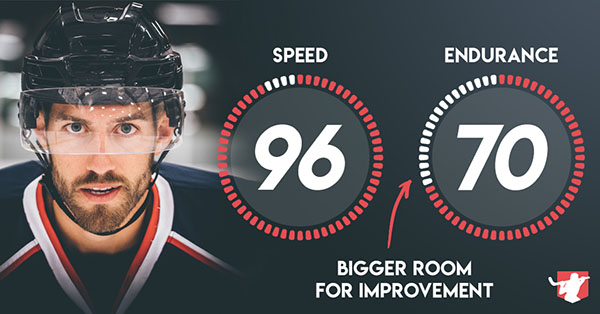
Of course, it’s going to be the conditioning or endurance which has a lot more room for improvement.
If your personal Puck Control rating is 92 but your Passing rating is 78 it’s going to be natural to dangle around the ice in your free time because you’re pretty awesome at that skill…
But the better bang for your buck to improve in games is going to be working on your passing.
Next time you’re on the ice or in the gym I want you to consciously think about what you need to do to become a better hockey player and put more focus into your weaknesses rather than your strengths — it’s going to pay off for you.
Not Addressing The Underlying Problem
This a tricky one because sometimes it’s just that the hockey player or hockey parent doesn’t actually know what the underlying problem is.
And a lot of the times you will need outside eyes (maybe a coach, scout, or performance coach) to point it out to you.
What do I mean by not addressing the underlying problem?
You can work on skating all day and pay hundreds of dollars for power skating lessons each year, but if you don’t have the ankle stability, mobility, and balance needed for elite edge work, you will never be able to get there.
You’re trying to solve a skating problem with more skating lessons, but the real issue is that your ankles aren’t built up properly.
Or maybe it’s your shot power that you’re trying to work on, so you’ve been ripping 300 shots a day in your driveway and spending hundreds of dollars testing the best sticks on the market.
But the real underlying problem with not having great shot power is that your core stability, power, and grip strength aren’t at a level that will let you improve your shot any further.
If you have a problem in your game and you can’t seem to fix it no matter how hard you work on it, there is usually an underlying problem that you can’t see.
When I was younger, I remember around high school hockey age, I started to struggle with conditioning.
I was playing other sports, staying active, doing conditioning and cardio training, and on the ice multiple times per week.
I couldn’t figure out what the problem was.
Looking back now, I’m fairly sure the underlying problem was that my nutrition and sleep were typical for a high school kid and not optimal for hockey performance.
Think about what you struggle with the most on the ice. Explosive speed, agility, shot power, reaction time, etc.?
Is there an underlying problem behind it? If you need help trying to uncover your potential underlying problem, feel free to leave a comment on this article or shoot me a message, and I will try to help.
Training Hard At The Wrong Things
“Moving the needle” means doing something that actually makes a meaningful difference. And many young hockey players spend too much time on things that don’t move the needle. It’s one of my biggest regrets as a teenager.
Hockey players only have so much time to train, especially once you factor in school, practices, games, family, sleep, and everything else going on.
So if you’re going to spend extra time working on your game, I think it’s worth asking a pretty simple question:
Is what I’m doing actually helping me become a better hockey player?
One of the biggest mistakes I made when I was younger was training too much like a gym bro.
I wanted to get bigger. I wanted my squat and deadlift numbers to go up. I thought that if I became stronger in the gym, I would automatically become faster and better on the ice.
Strength matters. But getting better at lifting weights and getting better at hockey aren’t always the same thing. Hockey players need to be explosive. They need to accelerate quickly, produce force from one leg, push laterally, control their hips and ankles, change direction, repeat hard efforts, and stay strong in awkward positions.
And that’s only the physical side of the game.
You also have your stickhandling, shooting, passing, hockey IQ, decision-making, and all of the other skills that actually show up when you play.
The point isn’t that every minute of training has to look exactly like hockey.
For younger players, playing other sports and simply being active still has a ton of value too. Soccer, basketball, tennis, gymnastics, tag, or running around outside can all help build coordination and athleticism.
The point is that you don’t want to spend most of your extra training time chasing things that have very little transfer to the game.
If you’re spending five days a week trying to build bigger arms and a bigger bench press, but you’re slow, your conditioning isn’t great, and you rarely work on your puck skills, you’re probably focusing on the wrong things.
Hard work matters.
But where you put that hard work matters too.
If you want to join us and have a hockey-specific training plan laid out for you, that’s exactly what we do inside Hockey Domination. You can learn more here.
Leave a Reply